
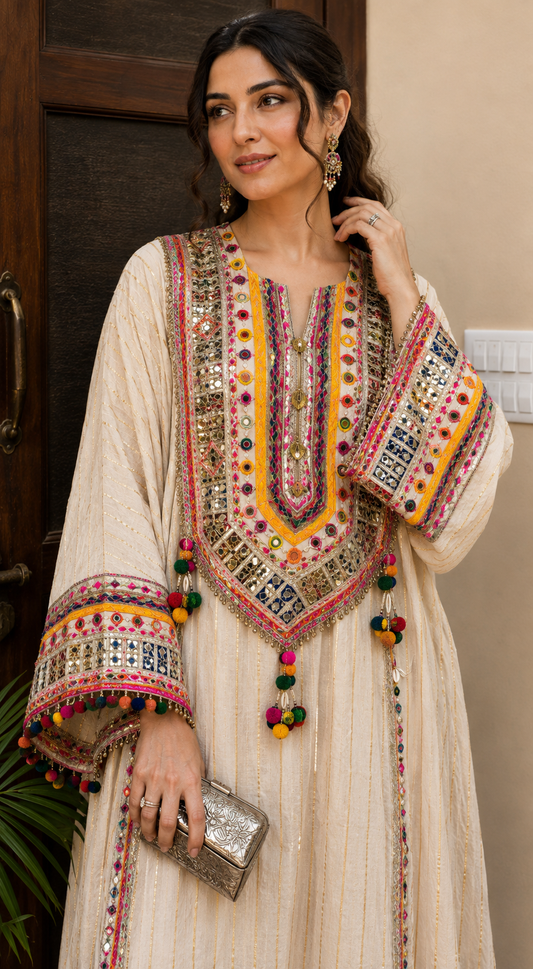

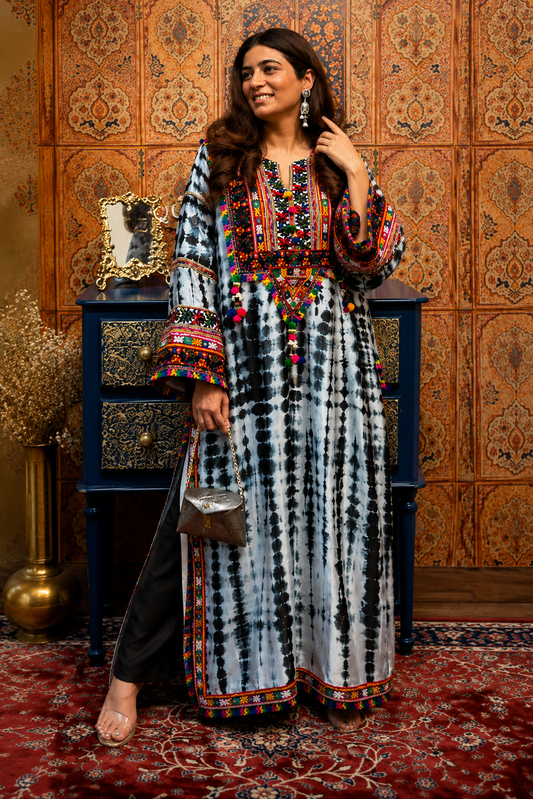


Why the Farshi Salwar Is the Biggest Fashion Trend of 2026
If you've spent even a few minutes scrolling through Instagram or Pinterest this year, chances are you've noticed one silhouette making an elegant comeback: the Farshi Salwar. From celebrity wedding appearances and Pakistani couture collections to Indian fashion influencers styling it for festive celebrations, this regal garment has become one of the most talked-about ethnic fashion trends: “the farshi salwar trend 2026”.

Unlike fleeting fashion fads, however, the Farshi Salwar isn't new. Long before it dominated social media feeds and bridal mood boards, it was reserved for queens, begums, and noblewomen who belonged to the grand courts of the Mughal Empire. With its dramatic floor-grazing flare, luxurious fabrics, and graceful movement, the Farshi Salwar has always represented sophistication, prestige, and timeless beauty.
Today, that same royal silhouette is finding a new audience. Modern women are rediscovering its effortless elegance, designers are reimagining it with contemporary tailoring, and luxury labels are embracing it as the perfect alternative to heavily embellished lehengas and conventional shararas.
So, what exactly is a Farshi Salwar? Where did it originate? Why has it suddenly become one of the biggest fashion trends of 2026? And how can you style this timeless silhouette for today's celebrations?
Let's explore the remarkable journey of one of South Asia's most iconic garments.
What Is a Farshi Salwar?
A Farshi Salwar is a traditional South Asian bottom wear distinguished by its exceptionally wide flare and dramatic floor-length drape. Unlike a regular salwar that gathers neatly around the ankles, the Farshi Salwar extends outward with generous pleats and extra fabric, creating a graceful silhouette that almost appears to glide across the floor as the wearer walks.
Its name comes from the Persian and Urdu word "Farsh," meaning "floor." True to its name, the garment gently trails along the ground, giving it an unmistakably regal appearance.
Traditionally, a Farshi Salwar is worn with:
● A long, tailored kurta
● A flowing embroidered dupatta
● Delicate jewellery
● Traditional juttis or embellished heels
What truly sets it apart is the volume. Authentic Farshi Salwars often require anywhere between 9 and 15 yards of fabric, allowing every movement to create an elegant cascade of folds. It's this dramatic drape that has made the silhouette synonymous with luxury for centuries.
Today, designers are introducing lighter fabrics, softer tailoring, and contemporary prints, making the Farshi Salwar easier to wear while preserving its iconic grandeur.
Farshi Salwar vs. Sharara, Gharara & Patiala: What's the Difference?
One reason the Farshi Salwar has sparked so much curiosity in recent years is that it's often confused with other traditional silhouettes. While each garment has its own cultural significance, the Farshi Salwar stands apart in both construction and movement.
|
Style |
Key Feature |
Origin |
Best For |
|
Farshi Salwar |
Wide, floor-grazing flare with continuous volume |
Mughal courts, Awadh & Hyderabad |
Weddings, festive occasions, luxury ethnic wear |
|
Sharara |
Flared from the waist with structured volume |
Mughal Tradition |
Weddings & Celebrations |
|
Gharara |
Fitted until the knees before dramatically flaring |
Awadh (Lucknow) |
Bridal & traditional occasions |
|
Patiala Salwar |
Multiple pleats with a relaxed ankle fit |
Punja |
Everyday ethnic wear & casual festivities |
While all four silhouettes celebrate traditional craftsmanship, the Farshi Salwar remains unmatched in its flowing elegance and royal appeal.
The History of the Farshi Salwar
The story of the Farshi Salwar begins in the magnificent courts of the Mughal Empire during the 17th and 18th centuries, where fashion was far more than personal style; it was a reflection of power, status, and cultural refinement.
Designed exclusively for queens, begums, and women of aristocratic households, the Farshi Salwar became a symbol of prestige. Its voluminous silhouette required extraordinary amounts of luxurious fabric, often crafted from fine silks, brocades, muslins, and richly woven textiles. The garment's sweeping trail wasn't merely decorative; it represented the opulence and grandeur of royal life.

As the Mughal Empire flourished, this distinctive silhouette travelled across the subcontinent, finding prominence in the royal courts of Awadh (present-day Lucknow) and Hyderabad. By the 19th and early 20th centuries, it had evolved into one of the defining garments of Nawabi fashion.
Women from noble families traditionally paired the Farshi Salwar with long embroidered kurtas, intricately crafted dupattas, and exquisite jewellery. Every element of the ensemble reflected refinement, making it a staple for royal ceremonies, celebrations, and formal court gatherings.
Unlike everyday clothing, the Farshi Salwar demanded grace. Its generous volume created a distinctive rhythm as the wearer walked, transforming every movement into an expression of elegance. It wasn't simply a garment; it was an experience of luxury.
How Cinema and Television Preserved a Royal Silhouette
While the Farshi Salwar gradually disappeared from everyday wardrobes, it never truly vanished from South Asia's cultural landscape. For decades, filmmakers and television producers preserved its legacy through historical dramas and period films, allowing newer generations to witness the grandeur of this royal silhouette long before its modern revival.
One of the earliest and most iconic cinematic representations came in Satyajit Ray's Shatranj Ke Khilari (1977). Set in the royal courts of 19th-century Awadh, the film beautifully captured the sophistication of Nawabi culture, with noblewomen dressed in authentic Farshi pyjamas, richly embroidered kurtas, and elegant dupattas. The meticulous costume design reflected the era's refined lifestyle and introduced audiences to one of North India's most graceful traditional silhouettes.

Just a few years later, Umrao Jaan (1981) further cemented the Farshi Salwar's place in popular culture. Starring Rekha in one of her most celebrated performances, the film remains one of the finest visual references for Lucknawi fashion. Throughout the movie, Rekha's wardrobe featured exquisitely crafted Farshi pyjamas paired with ornate dupattas and traditional jewellery, inspiring generations of designers and fashion enthusiasts with its timeless elegance.

The tradition continued decades later with Dastaan (2010), a critically acclaimed Partition-era drama that authentically recreated pre-Partition fashion. Female characters were frequently seen wearing long kurtas paired with flowing Farshi-style salwars, reminding audiences of the silhouette's deep historical roots and cultural significance across the Indian subcontinent.

The Farshi Salwar truly began attracting renewed attention through contemporary Pakistani television. In Noor Jahan (2024), the female leads showcased beautifully embroidered Farshi Salwars and Ghararas that celebrated heritage craftsmanship with remarkable authenticity. Every carefully curated ensemble reflected the richness of traditional South Asian fashion while introducing younger audiences to these classic silhouettes.
Soon after, Iqtidar (2024) became one of the biggest catalysts for the Farshi Salwar's modern revival. Anmol Baloch's portrayal of Mehrunissa, particularly her striking blue Farshi Salwar ensemble, quickly became a viral fashion moment. Screenshots flooded Instagram, fan edits circulated across TikTok and Reels, and fashion creators began recreating the look for weddings and festive occasions. Designers also responded by introducing similar Farshi silhouettes into their luxury pret and festive collections, accelerating the garment's popularity across South Asia.

Far from being relics of history, these films and dramas ensured that the Farshi Salwar remained woven into South Asia's cultural imagination. By preserving its royal elegance on screen, they paved the way for a new generation to rediscover and embrace one of the region's most iconic heritage garments, setting the stage for its remarkable resurgence as one of the defining fashion trends of 2026
Why the Farshi Salwar Became the Biggest Fashion Trend of 2026 in India
Fashion is often described as cyclical, but every once in a while, a trend returns with a renewed purpose. That's exactly what's happening with the Farshi Salwar in 2026.
The revival, however, didn't happen overnight. Around 2023 and 2024, Indian audiences began consuming significantly more Pakistani fashion content through Instagram, YouTube, Pinterest, and short-form video platforms. Luxury Pakistani designers continued showcasing Farshi Salwars in their festive and bridal collections, while widely watched dramas such as Iqtidar and Noor Jahan introduced younger audiences to the silhouette's regal charm. Every beautifully styled bridal sequence, festive celebration, and family gathering became a source of fashion inspiration, encouraging viewers to rediscover this forgotten royal garment.
As these looks gained popularity, social media quickly amplified the trend. Instagram Reels, Pinterest mood boards, and TikTok styling videos were soon flooded with creators recreating elegant Farshi Salwar looks for weddings, Eid celebrations, festive occasions, and destination events. What was once admired on-screen gradually became a must-have outfit for modern wardrobes.
Among the creators leading this revival is Asna Oberoi (@asnaoberoi_), whose graceful pastel Farshi Salwar ensembles have become a favourite among ethnic fashion lovers. Often paired with flowing organza dupattas, statement earrings, and understated makeup, her styling proves that the Farshi Salwar can feel effortlessly sophisticated while remaining true to its royal heritage.
Fashion creator Sukhmani Gambhir (@sukhmanigambhir) has also embraced the silhouette through beautifully curated festive looks that blend traditional craftsmanship with contemporary styling. Her farshi salwar era has inspired countless women looking for refined alternatives to conventional lehengas and shararas.
Similarly, Gurleen Gambhir (@gurleengambhir) has introduced a younger, fashion-forward perspective by pairing vibrant Farshi Salwars with modern accessories and fresh styling techniques, demonstrating how heritage garments can seamlessly fit today's celebrations.
One of the strongest advocates of the trend has been Mehak Bakshi (@mehakbakshi09), whose dreamy pastel Farshi Salwar outfits regularly feature across Instagram Reels and festive fashion inspiration boards. Her soft colour palettes, graceful draping, and minimal styling have encouraged bridesmaids, wedding guests, and fashion enthusiasts to embrace the silhouette for intimate celebrations and destination weddings.
Lifestyle and fashion influencer Kritika Khurana (@thatbohogirl) has further expanded the trend's appeal by incorporating Farshi-inspired ensembles into her contemporary ethnic wardrobe. By combining luxurious fabrics with modern minimalism, she has shown that heritage fashion can feel both timeless and effortlessly relevant for today's generation.
Together, these creators have transformed the Farshi Salwar from a historic royal garment into one of social media's most admired ethnic fashion statements. Their Reels, styling videos, and wedding edits have introduced millions of viewers to the silhouette, proving that centuries-old craftsmanship can thrive in the digital age. What once graced the courts of Mughal queens and Nawabi begums now dominates Instagram feeds, Pinterest inspiration boards, and festive wardrobes across India, making the Farshi Salwar trend 2026 one of the defining fashion trends.
Celebrities Leading the Farshi Salwar Revival
Celebrity fashion has always influenced festive wardrobes, and the Farshi Salwar's resurgence is no exception. Some of India's most celebrated style icons have embraced this regal silhouette, proving that heritage fashion can feel incredibly contemporary.
Sonam Bajwa (@sonambajwa)
If one celebrity has truly helped popularise the Farshi Salwar trend among today's generation, it is Sonam Bajwa.
One of Punjabi cinema's most celebrated actresses, Sonam has become synonymous with regal ethnic dressing. Whether she's wearing flowing Anarkalis, elegant sarees, or beautifully tailored Farshi Salwars, she consistently proves that heritage fashion can feel both luxurious and contemporary.
Her appreciation for Pakistani couture designers such as Hussain Rehar and Erum Khan has further strengthened the silhouette's popularity among Indian audiences. Rich fabrics, dramatic Farshi cuts, and intricate embroidery have become recurring elements in her wardrobe, inspiring countless brides and wedding guests to embrace this timeless style.

Alia Bhatt (@aliaabhatt)
Among the celebrities associated with the Farshi Salwar revival, Alia Bhatt's all-white ensemble became one of the most admired examples of understated luxury. Dressed in an ivory Farshi Salwar paired with a delicately embroidered kurta, she demonstrated that true elegance doesn't require heavy embellishments.
Instead, the dramatic flare of the salwar became the highlight of the look, while subtle embroidery added depth and texture. It was a reminder that timeless silhouettes often make the strongest fashion statements.

Kareena Kapoor Khan (@kareenakapoorkhan)
Few celebrities have influenced Indian ethnic fashion as consistently as Kareena Kapoor Khan. From her iconic Patiala suits in Jab We Met to her effortlessly elegant festive wardrobes, she has repeatedly brought traditional silhouettes back into the spotlight.
Her appreciation for luxurious fabrics, graceful tailoring, and understated glamour perfectly aligns with the Farshi Salwar's royal heritage. For women seeking classic ethnic inspiration, Kareena's style continues to demonstrate that traditional fashion never loses its appeal when worn with confidence.

Khushi Kapoor (@khushikapoor)
While established celebrities celebrate the Farshi Salwar's royal heritage, younger fashion icons like Khushi Kapoor are introducing it to an entirely new audience.
Known for her love of pastel palettes, refined tailoring, lightweight fabrics, and minimal accessories, Khushi represents a generation that appreciates tradition through a contemporary lens. Her aesthetic proves that heritage silhouettes don't have to feel old-fashioned; they can be modern, versatile, and effortlessly elegant.

Find Your Perfect Farshi Salwar with Reet Lifestyle
As the Farshi Salwar continues its remarkable revival in India, brands that understand both heritage craftsmanship and modern dressing are leading the conversation. One such label is Reet Lifestyle, whose thoughtfully curated collection beautifully reimagines this iconic silhouette for today's woman.
For those who appreciate understated elegance, the Ivory Farshi Salwar Set offers a refined interpretation of minimalist luxury. Featuring artistic botanical prints, flowing Farshi bottoms, and a beautifully bordered dupatta, it is perfect for elegant daytime celebrations and intimate festive gatherings.

Those looking to make a vibrant festive statement will appreciate the Sunehri Saga Farshi Salwar Set. Its rich yellow hue, handcrafted neckline detailing, softly flared silhouette, and sheer contrast dupatta capture the joy and warmth of Indian celebrations while remaining exceptionally comfortable.

For warmer months, the Summer Farshi Salwar Set demonstrates how this historic silhouette can be adapted for effortless everyday elegance. Lightweight, breathable, and beautifully tailored, it offers all the grandeur of a Farshi Salwar in a relaxed contemporary form.
If luxurious craftsmanship is your preference, the Pink Handwork Farshi Salwar Set with Organza Dupatta embodies timeless sophistication. Intricate hand embroidery, flowing Farshi bottoms, and a delicate organza dupatta create an ensemble that's ideal for weddings, Eid celebrations, festive evenings, and family occasions.
Meanwhile, the Gold Leather Yoke Farshi Set introduces a fresh contemporary perspective through breathable organic cotton, modern detailing, and clean tailoring. It proves that Farshi-inspired silhouettes aren't reserved solely for grand occasions; they can become part of everyday ethnic luxury.

Together, these collections reflect Reet Lifestyle's philosophy of preserving traditional craftsmanship while designing for the confidence, comfort, and elegance of modern women.
Step into the Timeless Elegance of Reet Lifestyle's Farshi Salwar Collection
If you're ready to embrace one of 2026's most celebrated ethnic fashion trends, explore Reet Lifestyle's thoughtfully curated Farshi Salwar collection. Inspired by royal heritage and designed for the modern woman, each ensemble beautifully blends traditional craftsmanship with contemporary sophistication, ensuring you feel elegant, confident, and effortlessly graceful at every celebration.


